For a development team, suddenly becoming involved in a legal issue may be stressful and frustrating.
However, finding a potentially relevant patent does not automatically mean that you must stop developing or selling the product. First, you need to examine patent P, confirm the specifications of product Y, and estimate the level of patent infringement risk.
This process is called a patent infringement analysis. It may also be called an infringement opinion.
The analysis may be carried out by a company’s in-house IP staff or by an outside patent attorney.

How to Assess Patent Infringement Risk
The first step is to compare product Y with the claims of patent P. The claims define the scope of patent protection.
For example, suppose that a claim describes “an apparatus comprising A, B, and C.”
If product Y has A and B but does not have C, product Y will generally not infringe the claim.
As a basic rule, patent infringement requires the product to include every element of the claim.
However, the meaning and scope of a claim may change depending on how its words are interpreted.
For example, suppose that a claim describes “an apparatus comprising A, B, and C, wherein C is adjacent to B.”
The meaning of “adjacent” may become an important issue.
A broad interpretation may be that C only needs to be next to B and does not need to physically touch B.
A narrower interpretation may require B and C to be in physical contact.
Suppose that product Y has A, B, and C, and that B and C are next to each other but do not touch.
Under the narrow interpretation, product Y may fall outside the scope of patent P.
The second step is to review the prosecution history of patent P.
This means checking what the applicant argued while the patent application was being examined.
For example, suppose that the applicant argued that a particular effect was achieved “because B and C are attached to each other.”
This argument may support a narrower interpretation in which B and C must be in physical contact. If product Y does not have this relationship, the infringement risk may decrease significantly.
The third step is to search for prior art that may invalidate patent P or support a narrower interpretation of its claims.
Prior art may include earlier patents, patent applications, technical papers, product manuals, and other publicly available information.
An analysis of whether a patent can be invalidated is called a patent invalidity analysis or invalidity opinion.
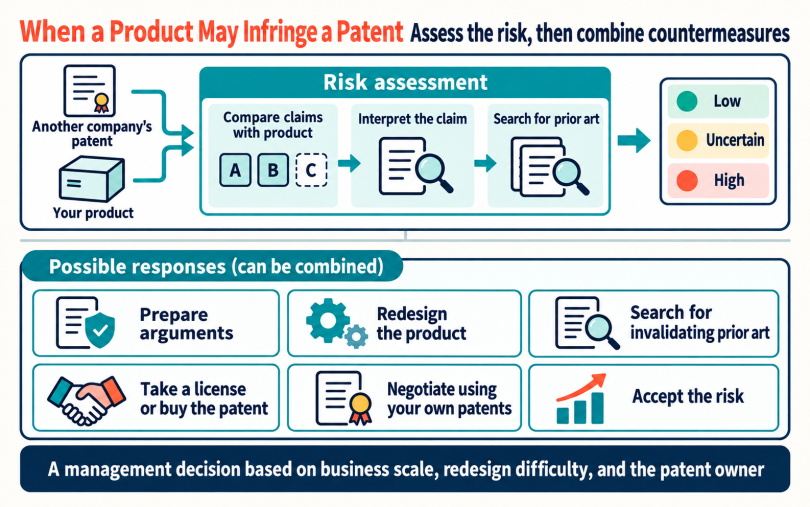
After these steps, we estimate the likelihood that product Y infringes patent P.
In some cases, we can conclude that the risk is very low. In other cases, we may conclude that the product is probably safe but that some uncertainty remains. In the worst case, the product may fall directly within the scope of the patent.
Patent infringement analysis often involves difficult judgment.
Even when a product appears to be safe, it is rarely possible to guarantee that the risk is zero. This is natural because an infringement analysis is usually requested when someone has already identified a potentially serious patent risk.
On the other hand, if the risk is high, we may have to recommend a design change. This can be difficult because a major design change may reduce product value, increase costs, delay the launch, or discourage the development team.
Six Ways to Manage Patent Infringement Risk
If the possibility of patent infringement cannot be ruled out, the following six measures may be considered.
In practice, companies often combine two or more of them.
Measure 1: Prepare Non-Infringement Arguments
A patent claim may have more than one reasonable interpretation. Under a broad interpretation, product Y may infringe patent P. Under a narrower interpretation, it may not.
We therefore consider the arguments that Company X may use when enforcing patent P and prepare counterarguments in advance. This is normally done as part of a patent infringement analysis.
Strong non-infringement arguments can improve your position in future negotiations or litigation.
Measure 2: Change the Product Design
Another option is to change the design of product Y so that it falls outside the scope of patent P.
A major design change may significantly reduce the infringement risk. However, such a change may also affect product performance, cost, appearance, or delivery schedules. For this reason, a major change is not always practical.
A smaller design change may reduce the risk without completely removing it. In that case, the design change may be combined with the non-infringement arguments described in Measure 1.
Measure 3: Find Prior Art That May Invalidate the Patent
You can search for prior art that shows that patent P should not have been granted. This may include documents that the patent examiner did not find during examination.
One option is to file an invalidation action and actively challenge the patent. Another option is to keep the strong prior-art documents as a defensive measure without immediately starting legal proceedings.
If Company X later tries to enforce patent P, presenting strong prior art may cause Company X to withdraw its claim or accept more reasonable settlement terms. Prior art can therefore be an important source of bargaining power.
Measure 4: Obtain a Licence or Buy the Patent
The risk may also be resolved through a financial agreement. For example, you may pay a royalty and obtain a licence to use patent P. Another option is to purchase patent P from Company X.
Even when seeking a licence or purchase agreement, it is useful to prepare other measures. Strong non-infringement or invalidity arguments may help you negotiate better terms.
Measure 5: Use Your Own Patents as Negotiating Tools
You may have another patent, patent Q, that covers a product or service of Company X. In that situation, both companies may face patent risks.
Patent Q does not automatically cancel the risk created by patent P. However, it may be used as a negotiating tool. The companies may agree to a cross-licence, allowing each company to use the other company’s patents. A cross-licence can reduce or remove the practical risk created by patent P.
If your company does not own a useful patent Q, purchasing a relevant patent from another party may also be an option.
When Google entered the mobile phone business, it acquired Motorola Mobility and obtained a large portfolio of mobile-phone-related patents. The acquisition is often discussed as having included a patent defence purpose.
Measure 6: Decide Not to Take Immediate Action
In some cases, a company may decide not to take immediate action. Patent enforcement requires time, money, and management resources. The patent owner may never discover the product or may decide that enforcement is not commercially worthwhile.
However, taking no action does not mean that there is no infringement. It means that the company has decided to accept the risk after considering factors such as expected sales, the likelihood of enforcement, the behaviour of the patent owner, and the cost of other measures.
This approach can be compared to ignoring a traffic signal. An accident may not happen, and the actual probability of an accident may be low. However, the conduct is still risky.
For this reason, a patent infringement analysis should consider not only the wording of the patent but also whether the patent owner is likely to enforce its rights.
When a possible patent infringement is found, there is rarely only one solution. A company may combine claim interpretation, design changes, prior-art searches, licensing negotiations, and its own patent portfolio. The appropriate response depends on both the legal risk and the commercial importance of the product.